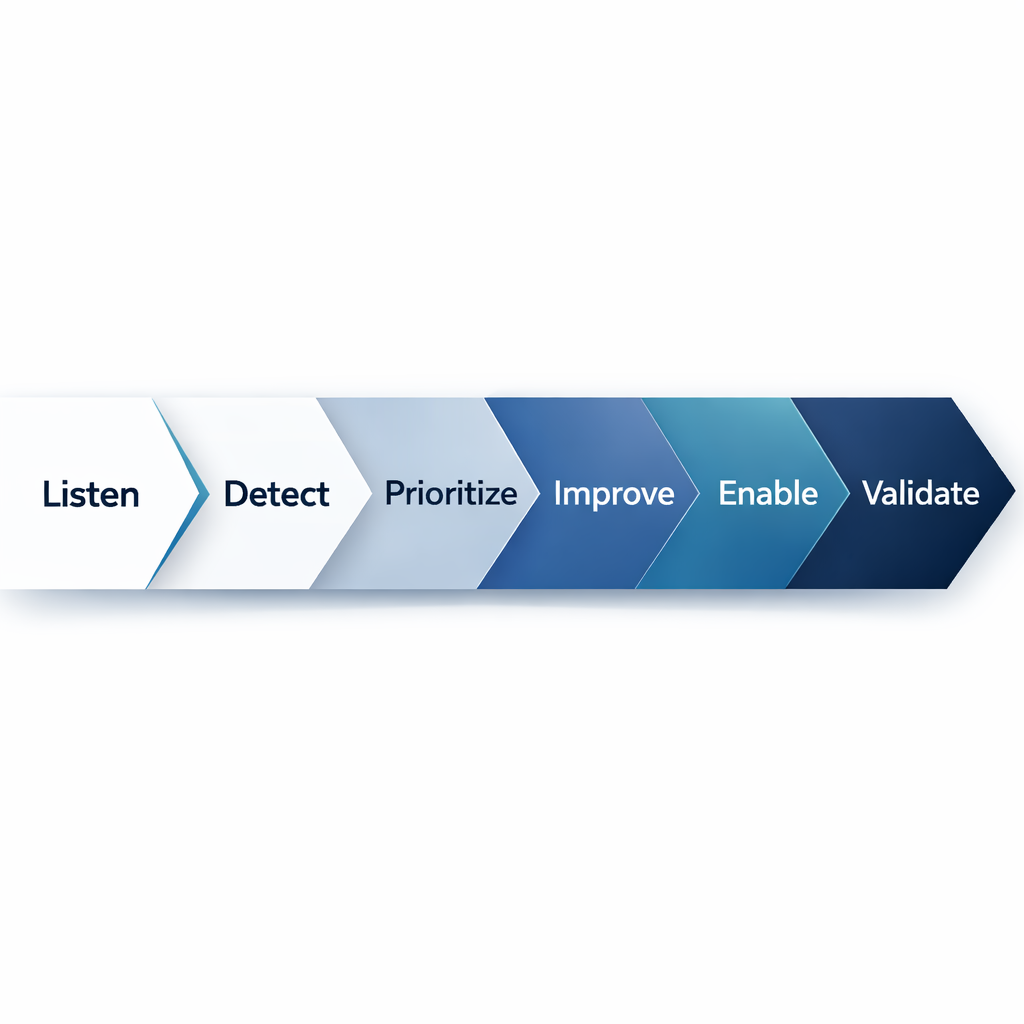
The DEX Practice Framework (DPF)
The DEX Practice Framework (DPF) is a vendor-neutral body of best practices that helps organizations design, govern, measure, and continuously improve Digital Employee Experience across the enterprise.

The DEX Practice Framework (DPF) provides a structured approach for turning Digital Employee Experience (DEX) from an isolated toolset or reporting function into a managed business capability. It helps organizations define how DEX should be governed, measured, operationalized, and improved over time, while creating alignment across technology, support, engineering, change, communication, and business priorities. DPF is designed to give leaders and practitioners a practical framework for building DEX programs that are measurable, repeatable, and scalable.
DPF guiding principles
1. Design for employee outcomes
DEX should begin with the employee’s ability to work effectively, confidently, and without unnecessary friction.
2. Measure experience, not just system health
Technical performance matters, but availability, compliance, and uptime alone do not define a good employee experience.
3. Prioritize what creates the greatest friction
Not every issue deserves the same attention. Effort should be focused where employee impact and business consequence are greatest.
4. Treat DEX as a cross-functional discipline
DEX is not owned by one platform, one team, or one function. It requires coordination across EUC, service desk, engineering, security, HR, communications, and business stakeholders.
5. Build proactive capability
The goal is not simply to respond faster. The goal is to identify, prevent, and reduce experience issues before they disrupt work.
6. Use evidence to drive action
DEX decisions should be based on trustworthy data, meaningful signals, and validated insight rather than assumptions or anecdotal noise alone.
7. Make improvement continuous
DEX is not a one-time initiative. It is an ongoing discipline of measuring, learning, refining, and improving.
8. Align experience work to business value
DEX should connect clearly to productivity, adoption, resilience, support efficiency, risk reduction, and other meaningful business outcomes.
9. Make change easier to absorb
New tools, policies, updates, and ways of working should be introduced in ways that reduce confusion and improve adoption.
10. Build trust through transparency and purpose
Experience data should be used responsibly, communicated clearly, and applied in ways that support employees rather than create fear or surveillance concerns.